
Reflection
I spent years using a daily journal to manage the friction of school leadership, only to realise I was just archiving my stress. Documenting a difficult meeting, a stalled project, or an ambiguous decision gave me temporary relief, but it didn't actually resolve the pressure; it just left an open loop. I was essentially tracking the noise of my day without ever extracting the signal.
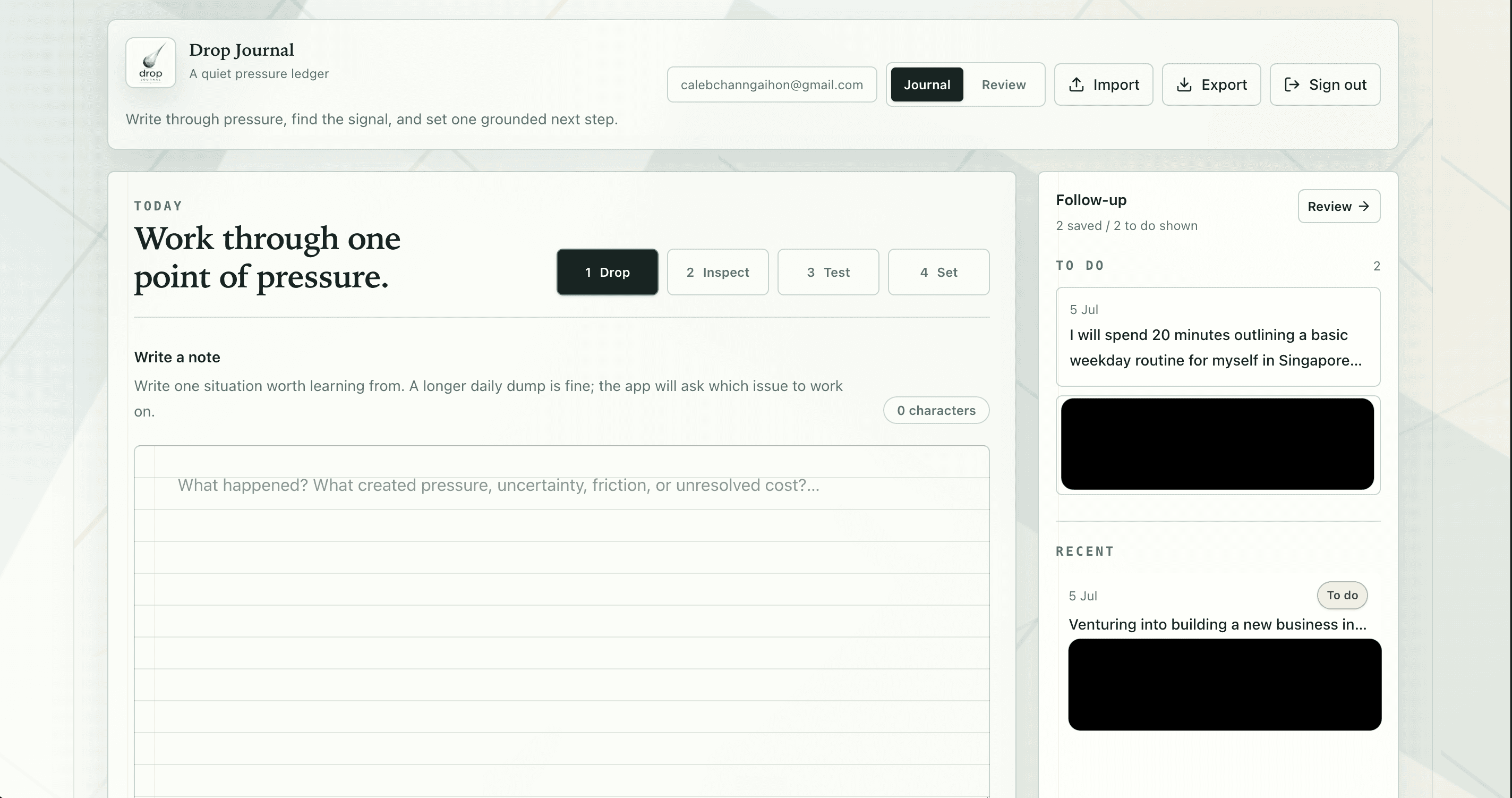
To solve this, I built Drop Journal. It is a quiet, AI-guided reflection space designed specifically to turn the messiness of a daily incident into a clear insight and a single, actionable commitment. It skips the open-ended, chatty fluff of a traditional chatbot to keep the process disciplined and focused entirely on practical execution.
The architectural challenge was building a workflow that enforces cognitive friction without causing fatigue. The system operates on a strict sequence: a user records a raw incident dump, which the backend condenses into a verified summary. From there, the diagnostic layer strips away framework jargon to present a single, sharp reflection question alongside choices to see the facts, find the choice, or keep the lesson. Instead of leaving the user in mid-air, the reconstruction layer suggests an action tailored to specific risk-design strategies—forcing the reflection to terminate in a doable, timeboxed next step.
I anchored this tool in the mechanics of true antifragility—the idea that daily pressure should reshape our perspective and leave us a little steadier, rather than merely exhausted. We talk constantly about professional resilience, but it cannot survive if reflection ends on the page. By forcing a clean break between raw pressure, honest inspection, and a concrete commitment, I wanted to help professionals close the loop on daily tension and exit every hard day with a clear footing for the next.